
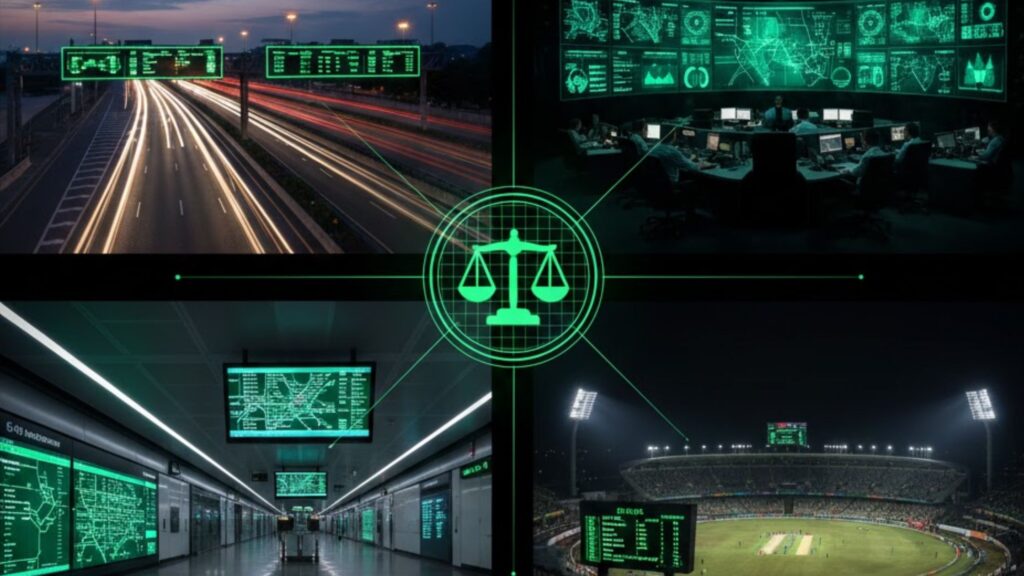
In mission-critical infrastructure, performance is not optional.
Highways, control rooms, metro systems, stadiums, and smart city networks rely on display systems that must operate flawlessly. While much attention is given to brightness, resolution, and connectivity, one often overlooked factor plays a fundamental role in performance:
Design geometry and structural balance.
In mission-critical display systems, geometry is not aesthetic. It is functional intelligence.
What Is Mission-Critical Infrastructure?
Mission-critical environments are those where system failure can cause:
- Safety risks
- Operational disruption
- Financial loss
- Public confusion
- Emergency response delays
Examples include:
- Highway Variable Message Displays (VMDs)
- Intelligent Traffic Management Systems
- Metro information displays
- Control room video walls
- Stadium-scale LED systems
In these environments, design precision directly affects reliability.
Geometry: The Foundation of Structural Stability
Geometry determines how a display system:
- Handles wind load on highways
- Distributes weight across mounting structures
- Maintains alignment over long spans
- Supports seamless modular integration
For large highway gantry-mounted displays, even minor structural misalignment can lead to:
- Visual distortion
- Mechanical stress
- Reduced lifespan
- Maintenance complexity
Proper geometric planning ensures:
- Even load distribution
- Reduced vibration
- Long-term durability
- Clear visibility from multiple angles
In infrastructure design, symmetry and proportion are engineering decisions—not decoration.
Balance: Performance Under Real-World Conditions
Balance in mission-critical displays operates on multiple levels.
1. Structural Balance
A display mounted over highways or urban corridors must remain stable under:
- High wind speeds
- Temperature variations
- Heavy rainfall
- Dust exposure
Balanced weight distribution ensures structural integrity and prevents long-term deformation.
2. Visual Balance
In critical communication systems, visual clarity is essential.
Balanced design ensures:
- Optimal contrast ratios
- Even brightness distribution
- Legible typography
- Proper spacing of alerts and symbols
For example, in Smart Variable Message Displays (VMDs), improper layout geometry can delay driver comprehension by crucial seconds.
In road safety scenarios, seconds matter.
3. Energy Balance
Modern intelligent display systems must also maintain power efficiency.
Balanced design integrates:
- Smart brightness control
- Energy-optimized LED placement
- Solar or hybrid power integration
- Thermal management systems
This ensures performance without excessive energy consumption.
Why Design Matters in Real-Time Communication
Mission-critical displays are not decorative screens. They are communication tools operating in dynamic environments.
Design influences:
- How quickly a driver reads a warning
- How clearly a metro passenger identifies a platform change
- How effectively a control room operator monitors live feeds
- How safely a crowd responds to emergency instructions
Good design reduces cognitive load.
Poor design increases reaction time.
In infrastructure, reaction time can directly impact safety outcomes.
The Science Behind Visibility and Comprehension
Display effectiveness depends on:
- Viewing distance
- Angle of visibility
- Pixel pitch selection
- Font geometry
- Color contrast
- Message hierarchy
For highway displays, geometry determines how text scales across long viewing distances.
Balanced message layout ensures:
- Key warnings are prioritized
- Speed advisories are instantly noticeable
- Icons support text clarity
- Messages remain readable in fog or glare
This is where design and engineering converge.
Control Rooms: Geometry at Scale
In centralized traffic or infrastructure control rooms, video walls must maintain:
- Perfect alignment
- Seamless panel integration
- Uniform brightness
- Accurate color calibration
Even minor geometric inconsistencies can create visual fatigue and operational inefficiency.
Balanced video wall design improves:
- Monitoring precision
- Operator comfort
- Decision-making accuracy
Design directly influences operational performance.
Stadium and Large Venue Displays
During high-energy environments like IPL seasons, large-format displays must:
- Maintain structural stability
- Handle continuous brightness output
- Deliver synchronized visuals
- Avoid pixel distortion
Here, geometry affects both:
- Visual immersion
- Engineering safety
Arena-scale displays require precision planning to balance visual scale and structural reliability.
Geometry and Sustainability
Well-balanced systems reduce:
- Mechanical stress
- Energy waste
- Maintenance frequency
- Replacement cycles
Sustainable infrastructure is not just about renewable energy-it is about intelligent structural design that lasts longer and operates efficiently.
Geometry contributes to lifecycle optimization.
Intelligent Infrastructure Requires Intelligent Design
As India moves toward:
- Smart mobility systems
- AI-enabled traffic management
- Sustainable infrastructure integration
- Data-driven urban planning
Display systems are becoming central to real-time communication networks.
Organizations operating in intelligent infrastructure, including Vulcan AIC, focus on designing mission-critical display systems where geometry, balance, and engineering precision work together.
Because in high-performance environments, design is not surface-level-it is system-level.
Precision That Performs
In mission-critical environments, design is not optional. It is a responsibility.
Geometry ensures structural stability.
Balance ensures long-term performance.
Intelligent design ensures clear communication.
At Vulcan AIC, we engineer mission-critical display systems built on precision geometry, structural balance, and intelligent control integration. From highway Variable Message Displays to control room video walls and large-format arena displays, our solutions are designed for reliability, clarity, and long-term performance in real-world conditions.
When infrastructure cannot afford failure, design must be engineered to perform.
Vulcan AIC delivers display systems where performance is not just promised – it is built into the structure.

